

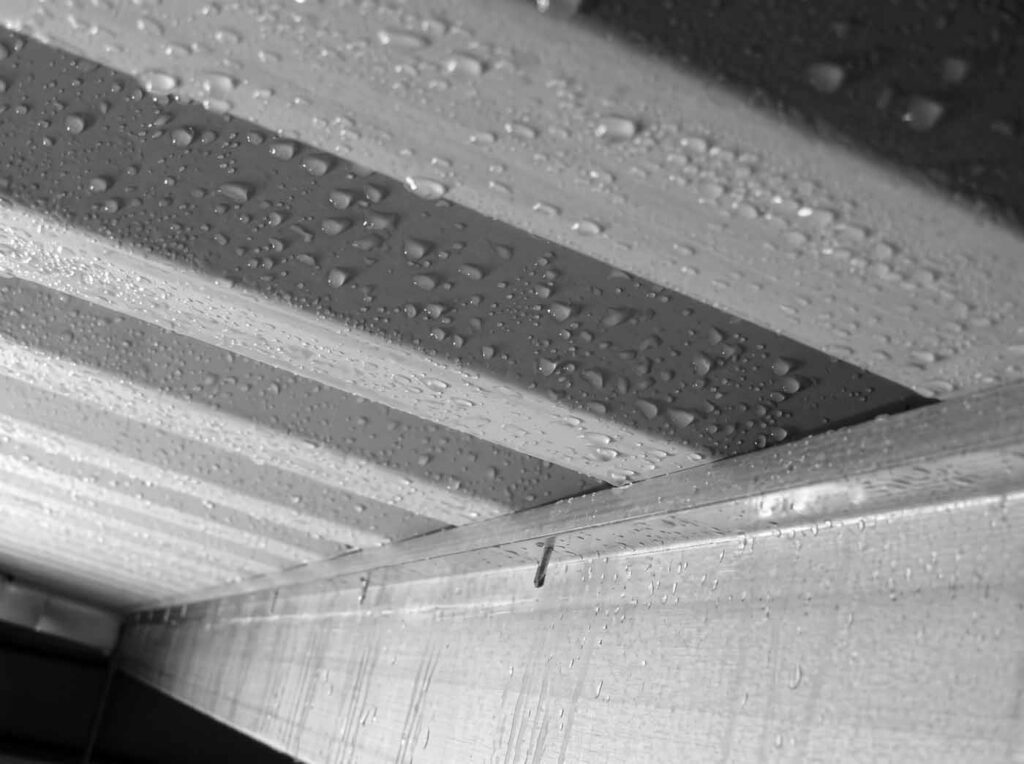
Condensation under a metal roof can look very similar to a leak. You might notice damp insulation, moisture on timber, staining on the ceiling or droplets forming beneath the roofing sheets. The immediate assumption is often that rainwater has found its way through the roof, but sometimes the moisture is coming from inside the house.
We see this become particularly noticeable during Christchurch winters, when cold roofing meets warm, moisture-laden air from inside the home. Understanding why that happens is important because fixing condensation requires a different approach from repairing a roof leak.
Why Does Condensation Form Under A Metal Roof?
Condensation forms when warm, humid air meets a cold surface and cools below its dew point. On a cold Christchurch morning, the underside of metal roofing can provide exactly that surface.
Moisture inside a home comes from everyday activities such as:
- showering and bathing
- cooking
- drying clothes indoors
- breathing
- unvented or poorly vented appliances
Warm air naturally rises. If moisture can move through the ceiling and into the roof cavity, it may condense when it reaches colder roofing components.
That does not mean metal roofing is inherently prone to problems. A well-designed residential roofing system in Christchurch manages moisture through the combination of roofing, underlay, insulation, ventilation and good building detailing.
Is It A Roof Leak Or Condensation?
This is one of the first things we try to establish.
A roof leak is generally linked to an external pathway, such as damaged flashings, loose fixings or another failure that allows rainwater in. Condensation is generated by moisture already within the building.
The timing can provide clues.
If moisture appears mainly during or immediately after rain, a leak becomes more likely. If it is worst on cold mornings, during winter or after periods of high indoor humidity, condensation should also be considered.
Location matters too. A concentrated wet patch may point towards a leak, while widespread moisture across the underside of a roof can suggest condensation.
Our guide to common roof leak sources in Christchurch explains some of the external trouble spots that need to be ruled out first.
What Does Roof Underlay Do?
Underlay sits beneath metal roofing and plays an important role in moisture management.
One of its jobs is to temporarily absorb or manage condensation that develops beneath the roof cladding, rather than allowing droplets to immediately fall onto insulation or ceiling materials.
Underlay cannot solve an ongoing moisture problem by itself. If large amounts of humid air continually enter the roof cavity, the system may never get enough opportunity to dry properly.
Older Christchurch homes can also have roofing underlay that has deteriorated or no longer performs as intended. During re-roofing in Christchurch, removing the existing roofing gives us an opportunity to assess the condition of the underlying components and install the new roofing system correctly.
Does Adding Roof Ventilation Fix Condensation?
Sometimes ventilation is part of the solution, but simply adding vents is not always the right answer.
The real question is where the moisture is coming from.
If humid air is continually escaping from bathrooms, kitchens or living areas into the roof cavity, improving extraction and limiting that moisture pathway may be more important than adding roof vents.
The roof design matters too. A conventional pitched roof with a generous cavity behaves differently from a skillion roof where there may be very little space between the ceiling and roofing.
We look at the whole system rather than assuming every condensation issue has the same fix.
Signs That Condensation Is Becoming A Problem
Occasional moisture does not always mean major roof damage is underway, but persistent condensation should be investigated.
Watch for:
- damp or compressed insulation
- mould or mildew in the roof cavity
- staining on framing
- water marks appearing without obvious rainfall
- musty smells
- corrosion developing around roofing components
- repeated moisture on the underside of roof sheets
Our article on the Roof Anatomy Explained is useful if you want to understand how underlay, battens, soffits and the roof covering work together.
How Can Roof Condensation Be Reduced?
The right fix depends on what is causing the moisture.
Practical measures may include improving bathroom and kitchen extraction, avoiding drying large amounts of washing indoors without ventilation, addressing ceiling air leakage and making sure insulation has been installed correctly.
Roof ventilation or other changes may also be appropriate, depending on the building design.
If moisture has already contributed to corrosion, damaged flashings or other roofing defects, roof repairs in Christchurch may also be required.
Get The Cause Right Before Fixing The Symptom
Condensation problems can be frustrating because the visible water does not always tell you where the real problem is. Treating it as a leak when the issue is internal moisture may achieve very little. Assuming it is condensation when rainwater is entering through a flashing is equally risky.
We prefer to establish what is happening first, then recommend the most practical response.
If you are seeing unexplained moisture around your metal roof or roof cavity, getting it assessed early can prevent damage to insulation, timber and the roofing system itself.